

“My health checkup said my BMI was high.” “They flagged my blood pressure and blood sugar at the same time.” “I’m concerned about my weight, but I’m not sure it’s something to bring to a clinic.” — Obesity disease is a diagnosis given not to carrying extra weight in itself, but to a state in which that weight is leading to illness.
In Japanese medical practice, “obesity” (himan) and “obesity disease” (himan-sho) are treated as two separate things. This page explains where that line is drawn, the diagnostic criteria, and what happens after your visit.
Keldsen Family Clinic offers both Psychosomatic Medicine and Internal Medicine under one roof, a 1-minute walk from ‘Oizumi Yubinkyoku’ bus stop, accessible by Seibu Bus from Oizumi-Gakuen Station. We are open on weekends and holidays and also offer telemedicine. “Going to a clinic feels a little scary” — we’d love to help you take that first step.
Please note that consultations are handled by our Internal Medicine department. We confirm any coexisting conditions with blood tests before deciding on a plan. If specialized treatment is needed, we coordinate referrals to partner medical institutions.
About Lifestyle-Related Diseases

Lifestyle-related diseases are a group of conditions in which daily habits — diet, exercise, alcohol consumption, smoking, and stress — play a role in their onset and progression. Common examples include hypertension, diabetes, dyslipidemia, and obesity disease.
Among these, obesity disease is the one most likely to overlap with the others. Excessive fat accumulation is involved in diabetes, hypertension, and dyslipidemia alike.
When visceral fat accumulation is combined with high blood pressure, high blood sugar, and abnormal lipid levels, the condition is known as “metabolic syndrome,” and it raises the risk of heart attack and stroke. What matters is not waiting for symptoms to appear, but taking action from the moment something is flagged on a health checkup.
What Is Obesity Disease?
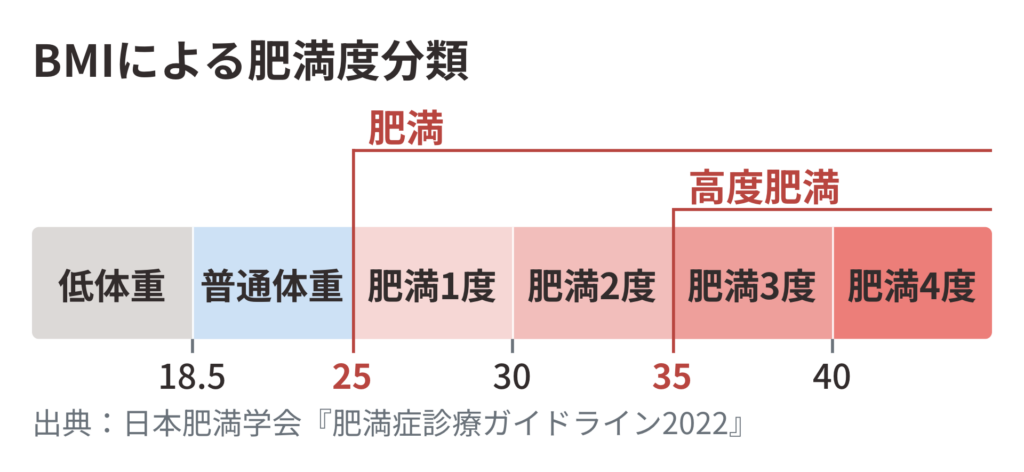
Obesity is a state in which fat has accumulated excessively in adipose tissue, defined in Japan as a BMI (weight in kg ÷ height in m ÷ height in m) of 25 or higher. Obesity disease is obesity accompanied by one or more obesity-induced or obesity-associated health disorders, or by confirmed visceral fat accumulation — a state in which weight reduction is judged to be medically necessary. Obesity in itself is not a diagnosis.
This distinction comes from the Japan Society for the Study of Obesity’s Guidelines for the Management of Obesity Disease 2022. Japan uses a BMI of 25 or higher as the threshold for obesity (the World Health Organization’s threshold is 30 or higher).
What this page covers is obesity disease — obesity for which weight reduction is judged to be medically necessary. We are glad to hear concerns about weight and body shape as well, but whether treatment applies is determined after an examination and testing.
The health disorders the guidelines use for diagnosis are the following 11:
- Glucose intolerance (including type 2 diabetes)
- Dyslipidemia
- Hypertension
- Hyperuricemia or gout
- Coronary artery disease
- Cerebral infarction or transient ischemic attack
- Nonalcoholic fatty liver disease
- Menstrual abnormalities or female infertility
- Obstructive sleep apnea syndrome or obesity hypoventilation syndrome
- Musculoskeletal disorders (osteoarthritis and spondylosis deformans)
- Obesity-related kidney disease
When Is Obesity Disease Diagnosed?
There are two routes to a diagnosis. One is having any of the health disorders listed above. The other is being diagnosed with visceral fat obesity, even when no health disorder is present yet.
With visceral fat obesity, a waist circumference of 85 cm or more in men and 90 cm or more in women raises the suspicion of visceral fat accumulation. The diagnosis is confirmed when abdominal CT shows a visceral fat area of 100 cm² or more.
A BMI of 35 or higher is called “high-degree obesity.” When a health disorder or visceral fat accumulation is also present, it becomes “high-degree obesity disease,” and the weight-reduction goal is set separately.
On the other hand, if your BMI is 25 or higher but you have neither a health disorder nor visceral fat accumulation, you are not diagnosed with obesity disease. In that case the condition is “obesity,” and the stage you are at is one of watching for health disorders to appear.
At your first visit we measure height, weight, BMI, waist circumference, and blood pressure, and run blood tests (blood glucose, HbA1c, lipids, liver function, uric acid, kidney function) to check for coexisting conditions. Chest and abdominal X-rays and an electrocardiogram are performed as needed. Consultations are handled by Internal Medicine; when the main concern is eating behavior, you can also consult our Psychosomatic Medicine department.
What is useful to prepare before your visit is summarized in the range of obesity disease treatment covered by health insurance (in Japanese).
Symptoms and Characteristics of Obesity Disease

With obesity disease, the health disorders that build up alongside it are often found before the number on the scale becomes the issue.
Signs That May Indicate Obesity Disease
Signs That Tend to Show Up Physically
- You get out of breath on stairs or slopes
- You snore loudly, or feel very sleepy during the day
- Your knees, lower back, or hips hurt
- Your menstrual cycle has become irregular
- A health checkup flagged your blood sugar, lipids, blood pressure, or liver function
- You have gained weight over a short period with no reason you can point to
Complications That Can Develop if Left Untreated
- Atherosclerosis progresses, raising the risk of heart attack and stroke
- Fatty liver can progress to fibrosis of the liver
- Obstructive sleep apnea lowers sleep quality and raises blood pressure
- Degenerative joint disease (knees, hips, spine) narrows the range of what you can do
- Obesity-related kidney disease reduces kidney function
The lifestyle-related diseases most often found alongside it are explained on our Diabetes, Hypertension, and Dyslipidemia pages.
When to Consider an Early Consultation
- A health checkup flagged a BMI of 25 or higher together with your blood sugar, lipids, or blood pressure
- Knee or lower back pain is making it hard to move
- You have tried adjusting your diet on your own, but time has passed with nothing changing
We are open on weekends and holidays, and walk-ins are welcome (appointments take priority).
Treatment and Management of Obesity Disease
In treating obesity disease, weight reduction is a means rather than the goal. What we aim for is preventing and improving the health disorders caused by or associated with obesity.
The weight-reduction goals set out in the guidelines are 3% of current body weight over 3 to 6 months for obesity disease (BMI 25 to under 35), and 5 to 10% for high-degree obesity disease (BMI 35 or higher). Your actual goal is decided at your consultation, taking into account your age, coexisting conditions, and circumstances in daily life.
Whether medication is appropriate is determined through examination.
1. Dietary Therapy
Diet is the foundation of treatment. For obesity disease (BMI 25 to under 35), the guidelines set daily energy intake at 25 kcal or less per kilogram of target body weight. Target body weight is calculated from your height, so we will give you the figure at your consultation.
- Nutrient balance: roughly 50 to 65% carbohydrates, 13 to 20% protein, and 20 to 30% fat
- Extreme carbohydrate restriction: short-term weight loss has been reported, but there is no evidence of long-term effectiveness
- Don’t skip meals: skipping breakfast or lunch leads to eating a large amount at night
The specifics of how to build your meals are something we work out together during your consultation.
2. Exercise Therapy
Exercise is a pillar of treatment alongside diet, and improvements in blood pressure, serum lipids, and blood sugar have been reported.
- Aerobic exercise: walking, cycling, swimming, and the like — 30 minutes or more a day, or 150 minutes or more a week
- Strength training: best used in combination, starting with light loads
- Reduce time spent sitting: walk 10 more minutes a day than you do now (about 1,000 steps), even in short stretches
- If you have knee or lower back pain, or a heart or respiratory condition, talk with your doctor before starting
3. Treatment of Coexisting Conditions
Alongside your weight, we treat the conditions you have at the same time.
- High blood sugar, HbA1c, or blood pressure → evaluation and treatment for diabetes and hypertension
- Abnormal cholesterol or triglycerides → evaluation and treatment for dyslipidemia
- Abnormal liver function or uric acid levels → evaluation and treatment for fatty liver and hyperuricemia
- Snoring or strong daytime sleepiness → consider testing for sleep apnea
4. Keeping a Record of Your Weight and Test Results
Keeping records brings into view what is actually moving your weight. The guidelines also show that behavioral therapy built on records is effective for both losing weight and keeping it off.
- Weight: measure at the same time and under the same conditions, and put it on a graph
- Meals: note the times, snacks, and alcohol. Enough detail to see “the day I ate too much at night” is plenty
5. Self-Care in Daily Life
- Sleep: insufficient sleep affects appetite regulation. If you snore or feel very sleepy, we consider testing for sleep apnea
- Quit smoking: smoking accelerates atherosclerosis
- Moderate alcohol: decide the amount and the frequency in advance
- Eating behavior: when low mood or strong anxiety persists, appetite regulation can become disrupted. If you have been in a state where you cannot stop once you start eating, please also see where to turn when you cannot stop overeating (in Japanese)
Obesity disease is not a condition you are blamed for by the number on the scale. Checking what lies behind it and treating the coexisting conditions in order is what lowers your risk of complications in the future. If something was flagged at a health checkup, please feel free to reach out to Keldsen Family Clinic. We are a 1-minute walk from ‘Oizumi Yubinkyoku’ bus stop, accessible by Seibu Bus from Oizumi-Gakuen Station, and we also offer telemedicine.