

“A red rash appeared on my body.” “The itching keeps me up at night.” “My skin irritation just won’t clear up.” — Skin troubles like these are something most people experience at least once. The causes of rashes are varied, and it is not unusual for multiple factors — such as allergies, a weakened skin barrier, and stress — to be intertwined.
While skin conditions are often thought of as something only a dermatologist handles, mild initial stages and stable-phase management can also be addressed by an internal medicine physician or family doctor. At Keldsen Family Clinic, we welcome consultations about rashes and itching, providing medication therapy and moisturizing guidance tailored to your symptoms. When a condition is severe or requires specialized testing, we refer patients to a dermatology specialist.
We are located a 1-minute walk from Oizumi-Gakuen Station. Open on weekends and holidays, with telemedicine also available. Even if you simply want to talk through your concerns, please feel free to visit.
About Skin Conditions
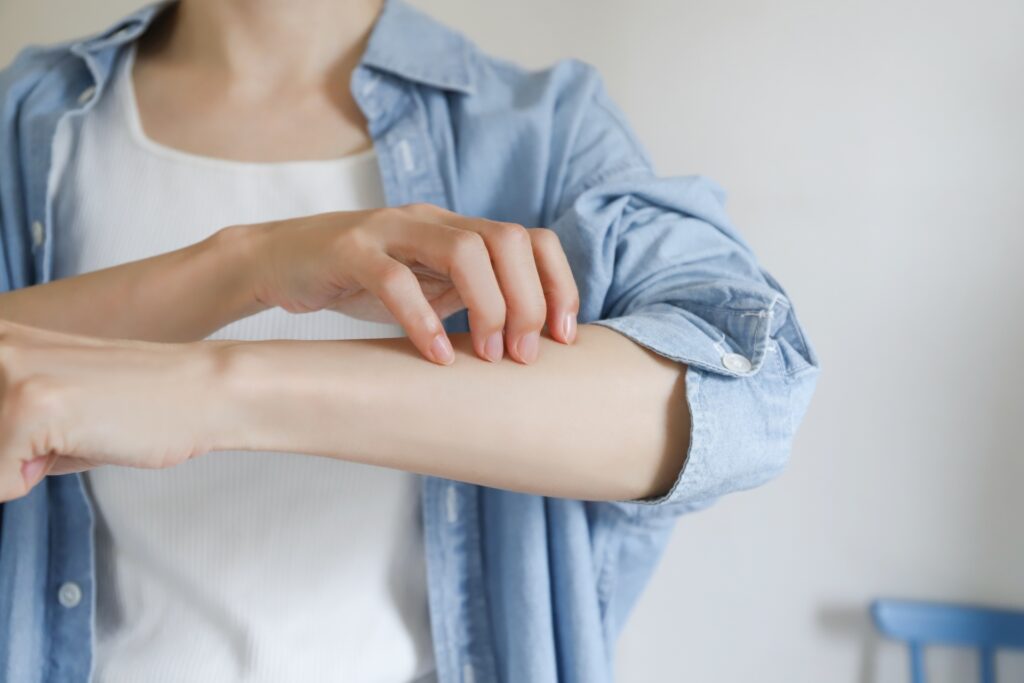
The skin is the body’s largest organ, covering the exterior and serving as a barrier that protects against foreign substances, ultraviolet light, dryness, and friction. It is also a tissue rich in immune cells; when bacteria, viruses, or allergens attempt to invade, the skin mounts an inflammatory response to fight them off.
When this defense mechanism is working well, there are no problems. However, when the skin barrier weakens or the immune response becomes excessive, inflammation, rashes, and itching develop. This is the fundamental mechanism underlying many skin conditions.
Skin conditions and allergies are closely related. Atopic dermatitis and hives often involve the immune system (IgE antibodies), and they may appear as part of the “allergic march” alongside hay fever and bronchial asthma (learn more about allergies and hay fever here). On the other hand, conditions such as contact dermatitis and eczema can occur through mechanisms unrelated to allergies — such as physical irritation, chemicals, or dryness.
Furthermore, stress, sleep deprivation, and disrupted lifestyle habits are known to upset the skin’s immune balance and worsen symptoms. The condition of the skin can be thought of as a “mirror” reflecting the state of the mind and body. Because Keldsen Family Clinic has a Psychosomatic Medicine department on site, we can also consider the psychological stress that may underlie your skin symptoms.
Common Skin Conditions That Cause Rashes
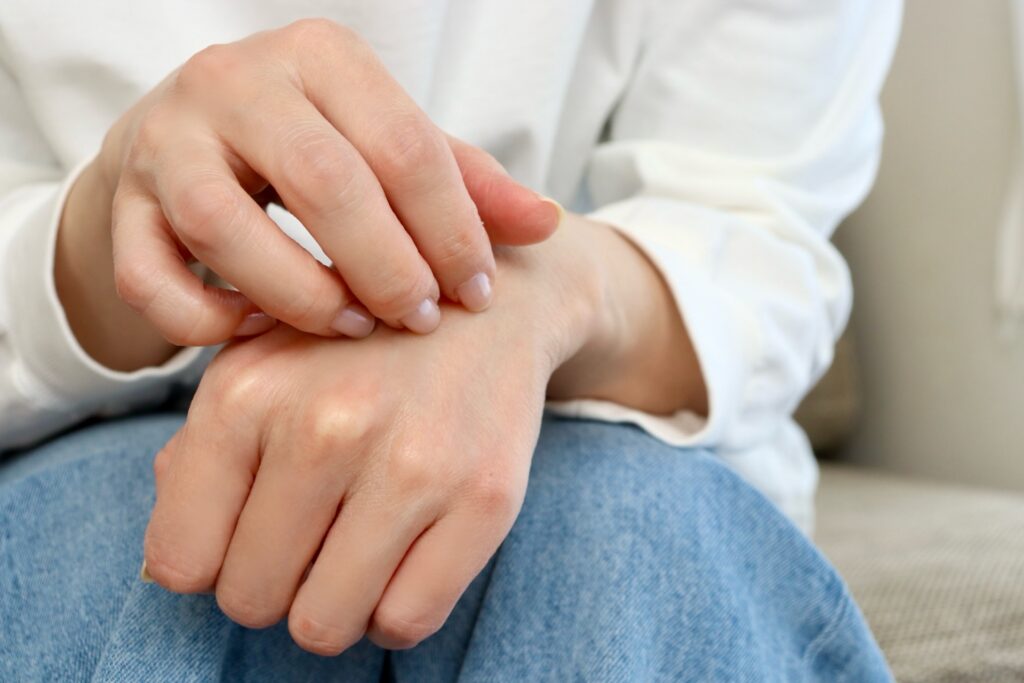
There are many types of skin conditions that cause rashes and itching. Here we introduce the most common ones that internal medicine physicians and family doctors encounter in daily practice.
Atopic dermatitis is a chronic skin condition that arises from a combination of weakened skin barrier function and an excessive immune response. Intensely itchy eczema repeatedly appears on the face, neck, inner elbows, and backs of the knees. While it often begins in infancy, it can persist into adulthood or even develop for the first time in adults. It is commonly seen in people who also have other allergic conditions such as asthma or hay fever.
Hives (urticaria) is a condition in which a part of the skin suddenly becomes red and raised (wheals — temporary, raised areas of the skin characteristic of urticaria), accompanied by intense itching. The raised areas often disappear within several hours but may reappear in different locations. Causes range widely — food, medications, infections, stress, and physical stimuli (cold, pressure, sunlight) — and a specific cause often cannot be identified. Hives are classified as acute (symptoms resolve within approximately one month) or chronic urticaria (wheals appear almost daily and persist for six weeks or longer).
Contact dermatitis (allergic or irritant) is inflammation that occurs when a substance comes into contact with the skin. Common causes include metals (nickel), cosmetics, detergents, plants, and rubber. It is divided into “allergic contact dermatitis,” where redness, itching, and blisters appear precisely where the substance touched, and “irritant contact dermatitis,” caused directly by the irritating substance itself.
Eczema is a broad term for an inflamed state of the skin that is not limited to a specific cause. It can present as redness, itching, oozing, or dryness. Identifying a single cause is often difficult, as both internal factors (constitution, stress) and external factors (dryness, irritation) typically play a role.
Seborrheic dermatitis is an inflammatory skin condition that occurs in areas with high sebum production — such as the scalp, hairline, eyebrows, sides of the nose, and around the ears. It is characterized by yellowish, scaly flakes, redness, and itching, with the involvement of a yeast called Malassezia. It tends to worsen with fatigue and sleep deprivation.
Because the symptoms of these conditions can overlap, self-diagnosis may be difficult. If you are unsure which condition applies to you, please consult with us first.
Characteristics and Symptoms of Skin Conditions
The symptoms of skin conditions vary according to the type of condition, its cause, and its severity. Some are defined primarily by “itching,” while others are characterized by visible changes in the skin. The approach also differs depending on whether the condition is acute or chronic and recurring.
Specific Symptom Examples
Itching and sensory symptoms
- Intense itching (often worse at night) and stinging or burning sensations
- Itching that disrupts sleep
Visible skin changes
- Redness (erythema)
- Papules (small, firm bumps) and wheals (temporary, raised areas of the skin characteristic of urticaria)
- Blisters and erosions (raw, oozing areas where the skin surface has broken down)
- Scaling (fine peeling of the skin surface) and lichenification (skin that has become thickened and leathery from chronic scratching or rubbing)
- Dryness, flakiness, and yellowish crusts or scaly skin patches
Patterns by body area
- Face and neck: Atopic dermatitis, seborrheic dermatitis, contact dermatitis (cosmetics, metal jewelry)
- Hands and fingers: Contact dermatitis (detergents, rubber gloves), hand eczema (dishpan hands)
- Trunk, arms, and legs: Atopic dermatitis, hives, eczema
- Scalp and around the ears: Seborrheic dermatitis
Acute versus chronic
- Acute (sudden onset): Hives, first episode of contact dermatitis, etc. It is important to consider whether there is a suspected trigger
- Chronic (recurring): Atopic dermatitis, seborrheic dermatitis, etc. A pattern of “getting better and then getting worse again”
When to seek urgent medical attention
- Rashes spreading across the entire body, accompanied by fever
- Swelling of the mouth, throat, or eyelids, with difficulty breathing (possible anaphylaxis)
- Large blisters spreading with skin peeling
Treatment and Management of Skin Conditions
Treatment for skin conditions is based on combining medication therapy to relieve symptoms, daily skincare, avoidance of triggers, and psychological support. Rather than aiming to “completely cure” the condition, the focus is on “controlling symptoms to maintain quality of life.”
Keldsen Family Clinic provides initial internal medicine care for mild-to-stable skin conditions. When symptoms are severe, widespread, or specialized testing (such as patch testing or photosensitivity testing) is needed, we refer patients to a dermatology specialist.
1. Medication Therapy
The central element of medication therapy for skin conditions is topical medications (creams and ointments).
- Topical corticosteroids: The most fundamental medication for suppressing inflammation. Multiple strengths (potency ranks) are available, and the appropriate one is selected based on the body area, symptom severity, and the patient’s age. When used properly, they are safe and effective, though prolonged indiscriminate use should be avoided — it is important to follow your physician’s instructions
- Tacrolimus ointment: A prescription medication that suppresses inflammation through a mechanism different from corticosteroids. Often used on the face and neck, where the skin is thinner (primarily for atopic dermatitis)
- Moisturizers (emollients): A foundational part of care that supports the skin barrier. Options include heparinoid preparations, urea-based products, and petroleum jelly, selected according to skin type and purpose. Continuing moisturization alongside medication therapy helps prevent recurrence
- Oral antihistamines: Taken by mouth to address itching and hives. Second-generation antihistamines, which are less likely to cause drowsiness, are commonly used
- Anti-allergic medications: For skin conditions related to allergies, medications that target the underlying inflammatory process may be chosen
For severe atopic dermatitis, injectable medications such as dupilumab and oral targeted therapies such as JAK inhibitors have been approved in recent years. These require eligibility assessment before initiation and regular follow-up, so management by a dermatology specialist is essential. Our clinic does not prescribe these medications and instead refers patients to dermatology.
2. Psychosocial Support
Because skin conditions manifest on the outside, they can lead to self-consciousness about appearance, anxiety about being seen by others, and diminished self-esteem. Severe itching and lost sleep also seriously impact quality of life. This psychological burden can create further stress, which in turn worsens skin symptoms — a vicious cycle that makes psychological care an integral part of treatment.
Keldsen Family Clinic has a Psychosomatic Medicine department on site, so we can address the psychological stress, anxiety, and sleep issues underlying skin symptoms all within the same clinic. There is no need to consult separately about your skin concerns and your emotional well-being. If your skin condition has been affecting your mood, or if hives have been appearing more frequently since a period of stress, please share that with us as well.
3. Considerations for School and Work
People with atopic dermatitis or contact dermatitis may need to make adjustments in their school or workplace environment.
- Organize the environment to avoid causative substances (metals, latex, specific detergents, etc.)
- In workplaces that involve frequent contact with water, choose appropriate glove materials (nitrile or cotton for those with latex allergies)
- Make moisturizing after washing a consistent habit
- If a child has atopic dermatitis, share information about the condition and how to manage it with the school or daycare
4. Home Management
Daily skincare and environmental management play a significant role in keeping skin conditions stable.
- Bathing tips: Use lukewarm water (approximately 38 to 40 degrees Celsius) for a short soak (about 10 to 15 minutes). Lather soap thoroughly and wash gently with the foam rather than scrubbing. Rinse with lukewarm water
- Timing of moisturizing: Within 5 to 10 minutes after bathing is optimal for moisturizer absorption. Make it a daily habit
- Clothing and bedding materials: Choose skin-friendly materials such as cotton or silk. Use a mild detergent and rinse thoroughly during laundering
- Bedding care: Dust mites and house dust can worsen atopic dermatitis and eczema. Wash bedding at least once a week, and regularly sun-dry or use a futon dryer
- Indoor environment: Aim for an indoor humidity of 50 to 60% (use a humidifier during dry periods, as dryness increases itching)
- Preventing scratching: Keep nails short. Wearing light gloves at bedtime can help prevent unconscious scratching during sleep
5. General Lifestyle Self-Care
Beyond medication and topical care, lifestyle habits themselves affect the condition of the skin.
- Diet: A balanced diet is the foundation. Fermented foods (yogurt, miso, etc.) are thought to influence the skin’s immune balance through their effect on gut health. Overly restrictive diets can lead to nutritional deficiencies, so if a food allergy is suspected, consult your physician first
- Sleep: Sleep deprivation can affect hormonal balance and immune function, potentially worsening itching. Getting enough sleep also supports the skin’s recovery process
- Stress management: Stress has been suggested to contribute to worsening symptoms. Finding relaxation methods that work for you — such as hobbies, exercise, or deep breathing — can be beneficial
- Smoking cessation and moderate alcohol intake: Smoking can weaken the skin’s barrier function and promote inflammation. Excessive alcohol consumption may also be associated with worsened itching
- Sun protection: Some skin conditions are aggravated by sunlight. Make use of sunscreen, hats, and UV-protective clothing
If rashes or itching are bothering you and you have been holding back, thinking “maybe I need to see a dermatologist,” know that Keldsen Family Clinic is set up to welcome consultations from the earliest, mildest stages. We are located a 1-minute walk from Oizumi-Gakuen Station, open on weekends and holidays, with telemedicine also available. Please feel free to reach out.